Features
-

Royal Enfield 'three'
Royal Enfield three cylinder Why Royal Enfield became involved with three and four cylinder engine designs soon after the outbreak of the 1914-18 war is unknown, although it should be recalled that the manufacture of machines destined for the civilian market was not prohibited until as late as 15th February 1917. Like most major manufacturers,…
-
Reference: BSA A50 and A65
Original A50 and A65 article (pdf) They’re ringing in the New Year at the BSA factory with a pair of brand-new big twins. Low-built and light (some 40 lb lighter than the current counterparts), the latest in the Small Heath line-up are packed with power and as compact in appearance as only unit-construction of engine…
-
Reference: Electrical breakdown
Electrical breakdwn advice (pdf) Electrical trouble? It's a possibility. But just how does one set about checking the electrics? Most modern machines, of course, feature coil ignition and an alternating-current system so, if there is life in the battery (a flick of the lighting switch can indicate that), the generator and rectifier can be ignored.…
-
Reference: AJS Model 31CSR Hurricane
AJS Model 31CSR Retired Lincolnshire man Tony Simpson knew he was buying a quality machine when he bought this late-model AJS 31CSR, for Tony, an experienced motorcyclist having passed his test in 1953 at the tender age of 16, already owned a Norton Dominator renovated by the same man. However, for such a go-faster thoroughbred,…
-
Road Test: Velocette LE MKIII
1964 Velocette LE MKIII The LE Velocette was such an oddball that it’s a sitting target for criticism. It weighed and cost more than half as much again as a contemporary BSA Bantam, but didn’t go much faster. Its complicated engine relied on old-fashioned side valves, and it appeared to have been styled by the…
-
Indian Scout Daytona
Indian Scout Daytona (pdf) Standing alongside his immaculately restored Indian Scout, Ken Burian looks ust like any other proud owner at contours meetings. However, this motorcycle is not just something he acquired to restore in retirement, but a machine he had a hand in creating. Not only that, but the immaculate side-valve V-twin is even…
-
Yamaha V-Max: development
Yamaha V-Max The V-Max was the most American of Japanese bikes: conceived, largely designed and initially sold only in the States. It resembled a two-wheeled Yank muscle-car, with big alloy air-scoops jutting out from the side of its dummy fuel tank. The fact that the chassis was barely able to cope simply added to the…
-
Triumph Ricardo
1922 TT Triumph Ricardo (pdf) Well, there is one man who will be able to say whether or not the 1922 TT-type Riccy turns out to be a delightful super-sports roadster, and he is the 1984/5 Association of Pioneer Motor Cyclists (APMC) President, Ormonde Gurr, of Great Brickhill, Beds. Something of a specialist in four-valve…
-
AJS 996cc V-twin
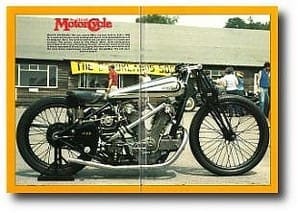
1930 AJS 996cc Vee-twin The massive 996cc supercharged AJS twin was certainly handsome, but it was a thorough-going pig to ride. So declares George Rowley, former works racer and trials man for the company. "We were down at Brooklands, passing-out R7 racers, when Bert Collier came over and said: 'You are our Number One, you…
-
Road Test: Ariel VB
1951 Ariel VB 598cc I don’t suppose that the few large side-valve singles still being made in the mid-1950s feature on many Christmas present lists. Such machines had abandoned their sporting pretensions while flappers were still dancing the Charleston; and being unashamedly marketed as sidecar tugs in the age of Rock’n’Roll wasn’t likely to set…




Free Digital Issue
Search
Tags
Bonhams Bristol Classic MotorCycle Show British motorcycle history Brough Superior classic bike autojumble Classic Bike Guide Winter Classic Classic Bike Hub Classic bikes Classic Bike Shows classic motorcycle auction UK classic motorcycle events UK Classic Motorcycle Mechanics classic motorcycles Editor’s Intro Insurance International Classic MotorCycle Show International Classic MotorCycle Show 2026 Island Racer Isle of Man TT Kempton Autojumble Latest Issue TCM Letters Mortons Archive Mortons Books motorcycle autojumble motorcycle parts motorcycle restoration Newark Showground News Normous Newark Autojumble Norton pre-order pre-war motorcycles Sponsored Content Stafford Stafford Classic Bike Show Stafford Classic Motorcycle Mechanics Show Stafford motorcycle show 2026 Stratford Autojumble TCM The Classic MotorCycle The Classic Motorcycle Mechanics Show Triumph Vincent Vintage motorcycles