Features
-

Reference: Norton Jubilee
Norton Jubilee This fine pair of Norton Jubilees are owned by Malmesbury Classic Club duo Terry Brock and Malcolm Wright. Terry (owner of the green and white one) is a long-time devotee of the Norton lightweight twins and has been featured several times in The Classic MotorCycle in the past (and became camera shy on…
-
Sunbeam Supreme TT
Sunbeam Supreme TT classic motorcycle road Then imagine how you would have felt when somebody asked you for a ride, on a busy morning, in the traffic. Rehearse your reply. David Nairne Clark coped like a man, though a source close to the family leaked the information that, in the subsequent 15 minutes, he wore…
-
Harley-Davidson 45
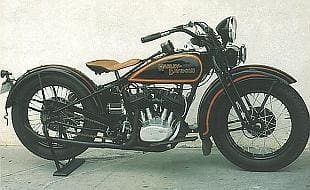
Harley-Davidson 45 sidevalve (pdf) Tough, dependable, and not very fast, the 45 cubic inch Harley-Davidson side-valve was what American motor cycling was all about from 1930 to the early 1950s. A product of the terrible depression and then the war years that discouraged creativity and innovation of design, the 750cc Harley catered to a market…
-
Ariel 4G and Watsonian
Ariel 4G and Watsonian sidecar test (pdf) From the point of view of the family man who may be in a position, financially, to buy the cheapest of current new cars simply as passenger-carrying transport, yet who seeks, nevertheless, to stay a motorcyclist, the combination represented by the 997cc Ariel 4G model and Watsonian 'Warwick'…
-
1938 Earls Court Motorcycle Show
1938 Earls Court Motorcycle Show (pdf) What the show reveals: Widespread adoption of rear-wheel springing. No fewer than nine different makes of motorised bicycle – cycle-type machines which any cyclist can learn to ride in a matter of minutes and which afford handy, inexpensive personal transport. More lavish use of colour and chromium on both…
-
Douglas Ladies
1914 Douglas Ladies (pdf) History books do not, on the whole, serve women well. With a few exceptions women's achievements, though they may be lauded at the time, are soon forgotten. This is never truer than after a war. During both world wars women were urged and encouraged to take on heavy manufacturing work, work…
-
BSA 500cc
1927 BSA 500cc single (pdf) Big Slow and Awkward. That was the reputation of Birmingham Small Arms' range of dependable but boring motor cycles. But this 1927 Sloper is something else. Fitted with a TT carburettor, the engine gulps a petrol-air mix with no consideration for fuel economy and packs a punch that has the…
-
1953 BSA A10 650cc
1953 BSA A10 650cc road test (pdf) On an ‘mph per pound’ basis, the B.S.A. 'Golden Flash' must be one of the least expensive high-performance projects offered to the buying public in post-war years. In fact, every mile indicated on the speedometer at the machine's maximum speed, costs approximately forty-two shillings and sixpence : a…
-
Indian Warrior PDF
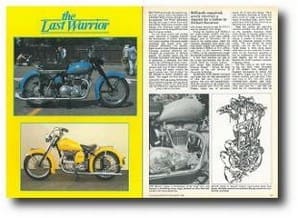
Indian Warrior: why it failed (pdf) Brutish but durable, the massive vee-twin has always held a fascination for American motor cyclists, brought up in the traditional "New World" philosophy that big and tough is better than small and refined. There were, of course, valid reasons why American motor cycles should have evolved along different lines…
-
Gnome et Rhone
Gnome et Rhone (pdf) Hardly had the smoke lifted from the battlefields of France after WWI than the famous British aircraft company Sopwith revealed plans, and a prototype, of a radical new motorcycle designed by Granville Bradshaw of the All British (Engine) Co Ltd — ABC. ABC had made a name immediately prewar with a…






Free Digital Issue
Search
Tags
Bonhams Bristol Classic MotorCycle Show British motorcycle history Brough Superior classic bike autojumble Classic Bike Guide Winter Classic Classic Bike Hub Classic bikes Classic Bike Shows classic motorcycle auction UK classic motorcycle events UK Classic Motorcycle Mechanics classic motorcycles Editor’s Intro Insurance International Classic MotorCycle Show International Classic MotorCycle Show 2026 Island Racer Isle of Man TT Kempton Autojumble Latest Issue TCM Letters Mortons Archive Mortons Books motorcycle autojumble motorcycle parts motorcycle restoration Newark Showground News Normous Newark Autojumble Norton pre-order pre-war motorcycles Sponsored Content Stafford Stafford Classic Bike Show Stafford Classic Motorcycle Mechanics Show Stafford motorcycle show 2026 Stratford Autojumble TCM The Classic MotorCycle The Classic Motorcycle Mechanics Show Triumph Vincent Vintage motorcycles